Posted on 1 Comment

Future Ready Leadership: Lessons from 2025 and Beyond

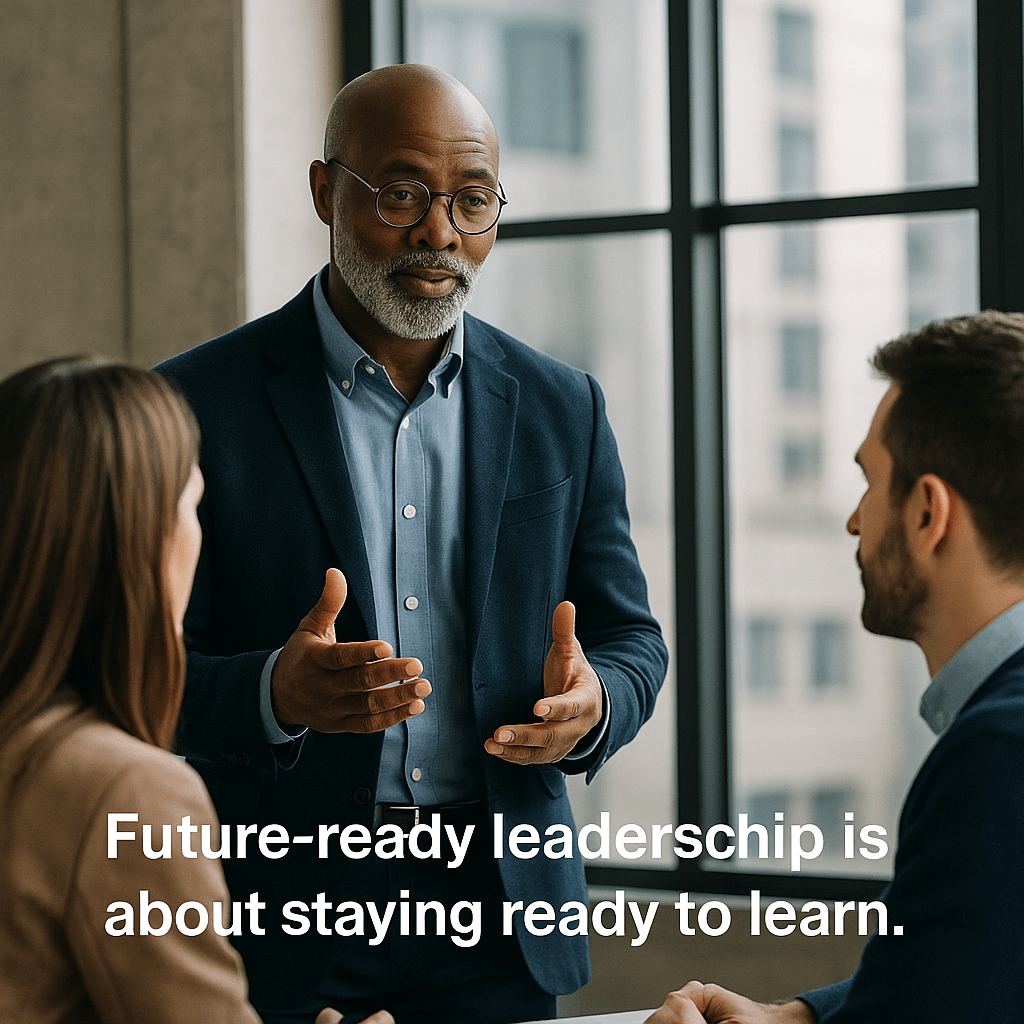
An experienced business leader speaks with two colleagues in a modern office with large windows overlooking a city skyline, symbolising forward-thinking leadership and continuous learning for the future.

The past year has tested every kind of leader. Unpredictable markets, evolving technology and new expectations around work have forced us all to adapt faster than ever.

Some leaders tried to go back to how things were. Others learned, adjusted and found new ways to move forward. Those are the ones shaping what leadership will look like in 2026 and beyond.

Future-ready leadership isn’t about having all the answers. It’s about staying ready to learn.

Adaptability beats certainty

In times of change, it’s tempting to search for solid ground. The perfect plan, the right process, the final answer. But if 2025 taught us anything, it’s that adaptability always wins over certainty.

According to *Deloitte’s Global Human Capital Trends report, 90% of executives believe building adaptable workforces is a top priority for long-term success. The challenge isn’t knowing change will come, it’s preparing people to navigate it confidently.

Future-ready leaders build flexibility into how they think, plan and lead. They don’t resist change. They anticipate it.

Trust drives performance

As technology takes on more tasks, the value of human connection has only grown stronger. The best leaders are those who create trust within teams, across functions and between people and technology.

*Gallup’s research continues to show that teams with high trust levels outperform low-trust teams by over 40% in engagement and productivity.

Trust isn’t just built through policies or performance reviews. It’s built through small, consistent actions. Following through on what you say, sharing context and giving credit where it’s due.

Clarity creates calm

Uncertainty fuels anxiety and anxious teams rarely perform at their best. Leaders who communicate clearly (even when answers are incomplete) give their teams something to hold onto.

Future-ready leadership is about translating complexity into direction. It’s about helping people see where they’re heading, even when the path isn’t fully mapped out.

Clarity creates calm. Calm enables progress.

Leading into what’s next

As 2025 comes to a close, it’s clear that the pace of change isn’t slowing down. The leaders who will thrive in the year ahead aren’t necessarily the most experienced or technical. They’re the ones who stay curious, trust their people, and communicate with purpose.

Leadership has never been about perfection. It’s about progress. One conversation, one decision and one learning moment at a time.

Want to go deeper?

If you’re looking to strengthen your leadership for the year ahead, explore my coaching and course options at CBDS. They’re designed to help you stay adaptable, focused and ready for whatever’s next.

*Sources

Posted on Leave a comment

Measuring People Development Impact: Why It Matters for Growth

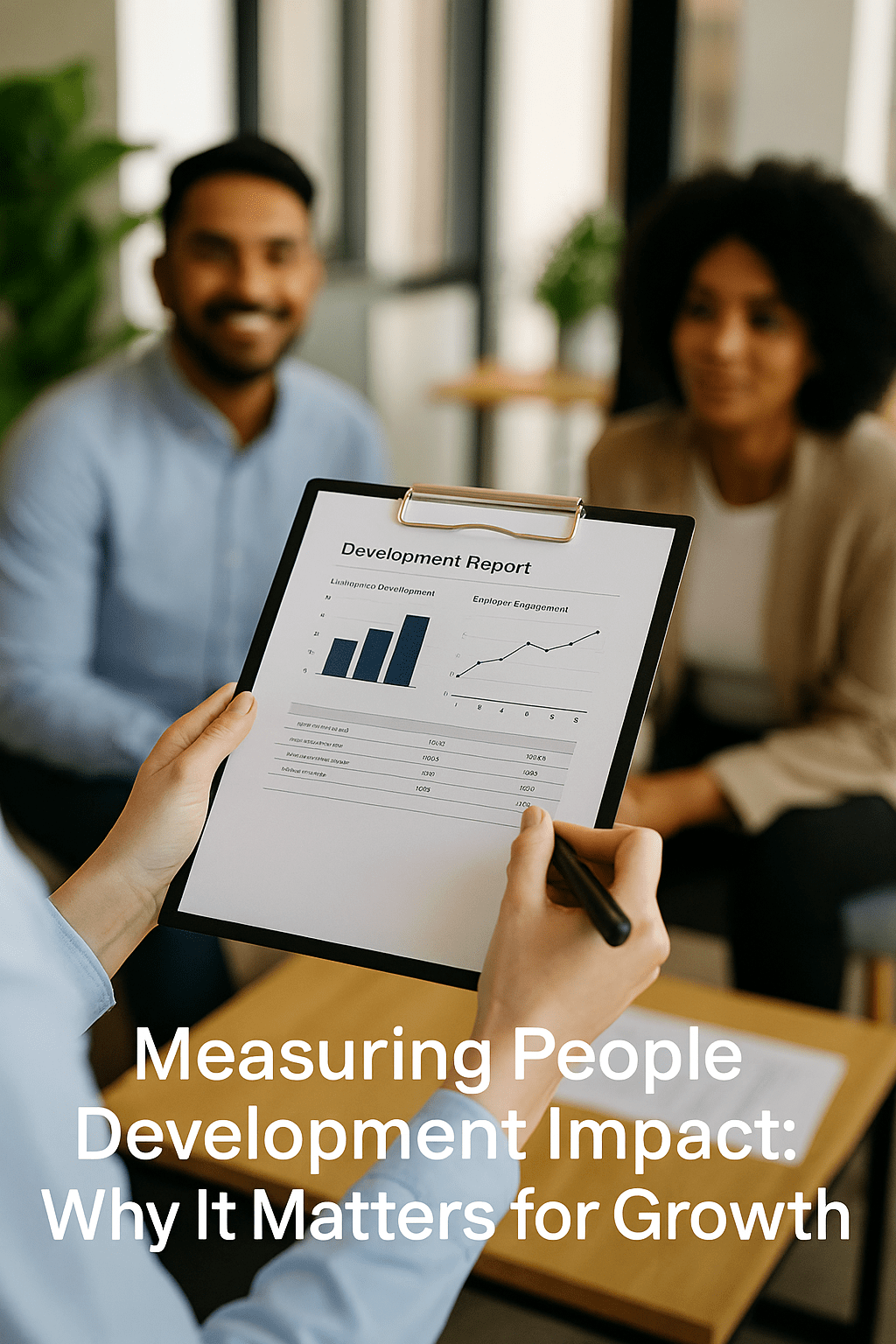
A professional team reviews a development report together in a bright modern office, with charts showing engagement and performance metrics, symbolising the link between people growth and business results.

For most businesses, people development sits at the top of the “important but not urgent” list. Everyone agrees it matters but when things get busy, it’s often the first thing to slip.

The challenge isn’t just finding time for development. It’s proving that it makes a real difference.

When you can measure how people growth supports business growth, it stops being a nice-to-have and starts becoming a strategic advantage.

Move beyond attendance metrics

Tracking participation in training sessions or workshops only tells part of the story. Just because people attend doesn’t mean they apply what they learn.

Smarter measurement looks at behaviour, not just activity. Are team members using new skills? Are managers seeing changes in performance or confidence?

Follow-up surveys, feedback loops or short learning reflections can give you real insight into whether development is actually landing.

Link learning to performance goals

If learning isn’t connected to your goals, it’s hard to prove its value. But when development feeds into measurable outcomes like improved retention, faster project delivery or higher customer satisfaction, you start to see the real ROI.

According to *LinkedIn’s Workplace Learning Report, 80% of executives say learning drives organisational success, but only 35% measure its business impact. That’s a huge gap and a missed opportunity.

When people development is tied to the metrics the business already cares about, it becomes part of the growth conversation instead of a side project.

Keep it simple and consistent

Measuring impact doesn’t need to be complex. The goal is to spot progress over time, not track every small change.

A few consistent measures like engagement scores, promotion rates or manager feedback can reveal long-term trends. Even qualitative data, like stories of improved collaboration or confidence, can be powerful when shared well.

Consistency matters more than sophistication. It’s better to track a few things regularly than lots of things once.

Turning measurement into momentum

When leaders can show the link between people growth and business results, they unlock momentum. Development becomes part of how success is defined. Not an extra cost or a tick-box exercise.

Because in the end, what you measure shows what you value. And the teams that measure growth in their people are the ones that sustain growth in their business.

Want to go deeper?

If you’d like to connect people growth to performance in a practical way, take a look at my course How to Develop Your Team. It’s designed to help leaders build, measure and sustain growth through their people.

*Sources

Posted on 1 Comment

Decision Making Under Pressure: How to Stay Clear When It Counts

A focused businesswoman reviews sticky notes on a glass wall in a modern office, symbolising calm thinking, clarity and structured decision-making under pressure.

When things move fast, decisions can start to feel like guesswork. Deadlines close in, information changes by the hour and the pressure to get it right builds quickly.

It’s easy to lose perspective in moments like that. Yet strong decision-making under pressure isn’t about having all the answers. It’s about staying clear when others can’t.

That clarity is what separates reaction from leadership.

Slow down to speed up

Pressure often tricks us into thinking that speed is the same as progress. The truth is that rushing usually leads to rework.

A study by *McKinsey found that executives who made decisions “slowly but with conviction” achieved better outcomes 65% of the time compared to those who acted fast but with uncertainty.

Taking a moment to pause to check assumptions, confirm priorities or sense-check your options can save hours of recovery later. Clarity often hides in the seconds we think we can’t spare.

Simplify the options

When stress rises, choice overload can make even simple decisions feel complex. The best leaders know how to strip problems back to their core by asking questions like:

  • What problem are we really solving?
  • What outcome matters most right now?
  • What happens if we do nothing?

This kind of simplification cuts through noise and helps your team focus on what really matters.

Trust the process, not just instinct

Experience gives intuition, but process gives consistency. The two work best together.

Whether you use a framework like SWOT, cost-benefit mapping or a simple “pros and cons” list, having a repeatable approach keeps emotion from running the show.

It also makes it easier to explain your reasoning later on. Things like a sign of calm or confident leadership when the stakes are high can go a long way.

As *Daniel Kahneman once said, “Nothing in life is as important as you think it is while you are thinking about it.” The moment might feel huge, but perspective comes from structure.

Staying clear when it counts

Pressure never disappears, but clarity can cut through it.

The leaders who make great calls under stress don’t rely on luck or gut feeling alone. They pause, simplify and use clear processes to guide their judgment.

Because when everyone else speeds up, the smartest thing you can do is slow down.

Want to go deeper?

If you’re ready to sharpen your thinking and make smarter decisions under pressure, explore my course How to Employ Strategic Thinking. It’s designed to help you build confidence, clarity and focus when it matters most.

*Sources

Posted on Leave a comment

Building Adaptable Teams in a Changing World

A diverse team of professionals collaborate in a bright modern office, gathered around a laptop in discussion, symbolising teamwork, adaptability, and learning in action.

Change isn’t slowing down. New tools, shifting markets and evolving customer expectations mean that what worked last year might not work next quarter.

The teams that thrive aren’t just the most skilled, they’re the most adaptable. They learn fast, adjust easily and stay focused even when things feel uncertain.

Adaptability isn’t luck. It’s something leaders can build.

Create safety before speed

When change hits, some teams freeze while others adapt. The difference often comes down to psychological safety. Whether people feel comfortable speaking up, asking questions and trying new things without fear of failure.

Research by Google’s *Project Aristotle found that psychological safety was the single biggest factor behind high-performing teams. Without it, even the most talented people hold back.

Adaptable teams move fast because they trust that learning is valued more than getting it right every time.

Build feedback into the flow

Teams that grow quickly don’t wait for annual reviews to learn what’s working. They share feedback often. Short, useful and focused on improvement.

This rhythm helps teams adjust before small issues become big ones. It also keeps learning continuous instead of episodic.

Try simple habits like quick end-of-week reflections, “what went well / what to tweak” check-ins or team retros after key milestones. The goal isn’t to criticise. It’s to keep improving together.

Reward learning, not perfection

If success is always defined as “getting it right,” your team will naturally play it safe. But when you recognise learning, experimentation and progress, you build resilience.

Adaptable teams aren’t afraid to try new tools, suggest ideas or test better ways of working. They know that effort and insight are valued just as much as outcomes.

As one of my favourite quotes puts it, “The measure of intelligence is the ability to change.” — Albert Einstein.

The leadership challenge

In a world that keeps shifting, the best thing you can give your team isn’t certainty, it’s confidence.

Confidence that they can adapt, learn and thrive no matter what comes next.

When you build adaptability into your culture, you’re not just preparing for change. You’re shaping a team that grows stronger because of it.

Want to go deeper?

If you’re ready to help your team stay motivated, engaged and adaptable, take a look at my course How to Develop Your Team. It’s built to help you unlock long-term performance through trust, feedback and growth.

*Sources

Posted on Leave a comment

AI Leadership Sweet Spot: Where Humans and Tech Work Best

A focused female business leader sits in a modern office interacting with a glowing holographic data display, symbolising the balance between human insight and AI technology.

Every few years, a new wave of technology comes along that promises to transform how we work. Right now, that wave is AI.

Some leaders are diving in headfirst, automating everything they can. Others are holding back, worried it will cause more problems than it solves. The truth as usual, sits somewhere in the middle.

The smartest leaders are finding a balance. They’re learning where AI can help, where it can’t and how to keep people at the centre of the process.

That’s the real AI leadership sweet spot.

Use AI for data, not direction

AI is brilliant at analysing data, spotting trends and speeding up repetitive work. But it doesn’t understand your customers, your culture or your strategy the way you do.

Great leaders use AI to inform decisions, not make them. They take what the tools surface and then apply judgment, empathy and context.

Think of AI as a second brain. Fast, capable, but not always right. You still need to lead with intuition and experience.

Keep people in the loop

When teams feel excluded from how AI is used, trust drops fast. The best leaders don’t just bring in new tools, they bring their teams on the journey too.

*Research from Harvard Business Review found that 72% of employees who understood why AI was being introduced felt more confident about its use at work. Transparency turns uncertainty into curiosity.

Share openly about what AI is doing, how it helps and what stays firmly human. It makes adoption smoother and strengthens your leadership credibility.

Lead with clarity, not complexity

AI can make things faster, but speed isn’t always progress. If you chase every shiny new tool, you’ll end up creating confusion instead of efficiency.

Set a clear purpose for how you use AI. Whether that’s improving response times, freeing up focus time or supporting better decision-making. Then make sure every tool or workflow serves that purpose.

Clarity is what separates leaders who use AI strategically from those who just experiment.

Finding the balance

AI isn’t replacing leaders. It’s challenging them to lead differently.

The real advantage isn’t in the technology itself. It’s in knowing how to combine the precision of machines with the perspective of people.

When you get that balance right, you move faster, stay focused and make smarter choices without losing the human touch that sets great teams apart.

Want to go deeper?

If you’re exploring how to bring AI into your business with confidence, take a look at my course AI in Business. It’s designed to help leaders build practical, people-first strategies for the AI era.

*Sources

  • Harvard Business Review: AI’s Trust Problem – explores what drives scepticism and how organisations build trusted AI.
Posted on Leave a comment

Lead Smarter Not Harder: New Rules for Growth

A focused leader stands in a bright, modern office while the background remains softly blurred, symbolising clarity, focus, and calm direction in a busy work environment.

Every leader reaches a point where working harder stops working. You can’t be across every detail, fix every problem or carry every decision on your own. The team grows, the business changes and what once made you effective starts to hold you back.

That’s the moment when leadership needs to evolve. It’s not about doing more. It’s about leading smarter.

Focus beats effort

Most leaders spend more time reacting than thinking. Meetings, messages and constant interruptions eat into the hours that matter most.

*A study by Microsoft found that the average manager loses almost two full days each week to communication overload. That’s time that could be used to think, plan and guide the team instead of chasing updates.

Protecting focus time isn’t a luxury. It’s what lets you lead with intention rather than reaction. Even 90 minutes of clear space a week can change how you see priorities and spot risks early.

Simplify what you measure

As teams grow, complexity creeps in. More projects, more reports, more dashboards. But if everything is a priority, nothing really is.

Try asking yourself one simple question: If we could only track three things, what would they be?

Focusing on fewer measures gives everyone a clearer view of progress. It also helps the team see how their work connects to the bigger picture.

The goal isn’t to manage more data. It’s to make sure everyone is looking in the same direction.

Share context, not control

Micromanagement often starts with good intentions. You want things done right, so you stay involved. The problem is, when every decision runs through you, growth stalls.

Smart leadership means sharing the “why” and letting your team decide the “how.” When people understand the purpose behind a task, they don’t need step-by-step oversight.

Clarity replaces control. And you get more time to focus on the strategic challenges that actually need you.

The shift that sustains growth

Working harder is about output. Leading smarter is about outcomes.

Take a look at your week ahead. Where could you simplify? What could you hand over? What time could you protect for thinking rather than reacting?

As *Peter Drucker said, “Efficiency is doing things right. Effectiveness is doing the right things.”

The best leaders know that growth doesn’t come from more effort. It comes from better direction.

Want to go deeper?

If you’re ready to build stronger focus and create space to lead, explore my course How to Employ Strategic Thinking. It’s designed to help you lead smarter, not harder.

*Sources

Posted on Leave a comment

Team Development: Why Investing in People Outperforms Tech Alone

Four professionals outlined in glowing blue line art climb a slope together, each helping the next, symbolising team development in business and the power of collaboration.

Technology grabs the headlines, but people drive performance. No matter how advanced the tools, a business can only grow as far as its team does. That’s why team development is one of the smartest investments a leader can make.

The Temptation to Rely on Tech

When companies hit challenges, the quick answer is often to buy new software, adopt automation or introduce another platform. These tools can help, but they’re not enough on their own. Without a capable, motivated team behind them, technology quickly reaches its limits.

Why Team Development Wins

  1. Stronger problem solving – Teams that learn and grow bring fresh ideas and spot opportunities faster.
  2. Better resilience – Well-developed teams adapt more easily when markets or priorities shift.
  3. Higher engagement – When people feel invested in, they’re more motivated and more likely to stay.
  4. Sustainable performance – Unlike tools that become outdated, people who grow with the business keep adding value.

How Leaders Can Start

You don’t need a huge budget or complex programs. Effective team development starts small:

  • Create time for regular 1:1s.
  • Encourage cross-functional collaboration.
  • Provide access to learning resources.
  • Celebrate growth and progress, not just results.

These simple steps build momentum and show your team that their development matters.

Why It Matters Now

In a world where tech evolves quickly, the only true competitive advantage is people. Businesses that invest in team development are more likely to scale sustainably, retain talent and outperform those that rely on tools alone.

As *Harvard Business Review noted, building a strong learning culture on your team improves engagement, retention and long-term performance.

Build a Stronger Team

That’s exactly what our course How to Develop Your Team is designed to support. It gives leaders the frameworks and tools to build capable, motivated teams that deliver results.

👉 Check out the Team Development course here

Transforming Potential into Performance

*Sources

Harvard Business Review (2023). Build a Strong Learning Culture on Your Team

Posted on Leave a comment

AI in Business: How to Avoid Wasting Money on the Wrong Tools

Pink piggy bank cracked open with glowing blue AI circuitry and coins spilling out, symbolising wasted money from adopting the wrong AI in business tools.

AI is everywhere right now. New platforms, apps and tools launch daily, each promising to transform how we work. For leaders, the temptation to dive in is strong. But without a plan, adopting AI can quickly become expensive guesswork. That’s why the smartest approach to AI in business is not “buy it all” but “buy it right.”

The Risk of Chasing Shiny Tools

Many companies rush to adopt AI without asking the right questions. The result? Subscriptions pile up, tools overlap and teams waste hours trying to stitch them together. Instead of saving time or money, leaders end up adding complexity and cost.

What to Look for Before You Invest

  1. Clarity on the problem – Don’t start with the tool, start with the challenge. What problem are you actually trying to solve?
  2. Fit with existing systems – The best tools integrate smoothly with what you already use.
  3. Scalability – Choose tools that can grow with you rather than ones you’ll outgrow in six months.
  4. Ease of adoption – If your team won’t use it, the tool has no value.

Why Planning Pays Off

The leaders who get the most out of AI in business are the ones who think strategically. They test tools in small pilots, measure results and roll out only what works. This avoids wasted spend and builds trust with their teams.

As *McKinsey research shows, companies that tie AI investments to clear business outcomes are more likely to see measurable returns than those that adopt tools without direction.

Build an AI Playbook That Works

That’s exactly what my course AI in Business is designed to help with. It gives you the tools, frameworks and confidence to make smarter choices about AI adoption.

👉 Check out the AI in Business course here

Transforming Potential into Performance

*Sources

McKinsey (2023). The State of AI in 2023: Generative AI’s Breakout Year

Posted on Leave a comment

Consulting in Business: How to Turn Advice into Action

Two business professionals shaking hands on a glowing digital bridge against a city skyline, symbolising consulting in business as partnership and turning advice into action.

There’s no shortage of advice out there. Articles, podcasts, webinars and consultants are everywhere. The real challenge isn’t finding advice., it’s turning that advice into action. That’s where consulting in business makes the difference. The right consultant doesn’t just hand you a report and walk away. They work with you to shape ideas into results.

The Problem with Traditional Consulting

Too often consulting is treated as a quick fix. Leaders bring someone in, they get a glossy presentation and then the report gathers dust.

The advice might be solid, but without support it rarely sticks. Teams may not know how to apply the recommendations, or they may resist changes that feel disconnected from daily realities. The result is wasted time, wasted money and missed opportunities.

I’ve seen companies spend months on beautifully designed reports that never got implemented. The missing piece wasn’t more ideas. It was a partner who could help translate those ideas into practical steps that people were willing to adopt.

What Effective Consulting in Business Looks Like

When done right, consulting is about partnership and outcomes, not just deliverables. Effective consulting in business includes:

  1. Understanding context – Good consulting starts with listening. Every business is different, with its own culture, challenges and goals.
  2. Practical recommendations – Actionable steps beat theory every time. The best advice is clear, simple and directly tied to outcomes.
  3. Collaboration – Consulting should feel like working with a partner, not being handed instructions from the outside.
  4. Follow-through – Real value comes when advice is tested, adjusted and implemented. Not left on a slide deck.

How to Make Consulting Work for You

Leaders can also take steps to make sure consulting delivers value.

  1. Be clear on goals – Before bringing in a consultant, know what success looks like. Are you trying to scale faster, improve customer experience or reduce costs?
  2. Choose listeners, not lecturers – The best consultants ask more questions than they answer at the start.
  3. Ask for a roadmap – Reports should come with a clear plan for execution, not just a list of recommendations.
  4. Involve your team early – If people feel part of the process, they are more likely to adopt new ways of working.

Why It Matters Now

Markets are moving fast. Leaders don’t just need ideas, they need partners who can help them adapt and execute.

Hybrid work, customer expectations and rapid advances in AI are shifting the ground under every business. A static plan quickly becomes outdated. Consulting in business today is less about being told what to do and more about co-creating a roadmap that evolves with your business.

As Deloitte notes in its Global Human Capital Trends report, agility and adaptability are now top priorities for leaders. The right consulting partner helps you build both.

Find the Right Support

That’s why we offer consulting services that focus on action and outcomes. From customer support optimisation to outsourcing partnerships, the goal is always the same: turn potential into performance.

👉 Explore our consulting services here

Transforming Potential into Performance

Posted on Leave a comment

Coaching for Scale-Ups: Why You Don’t Have to Go It Alone

Two business professionals climb a dark mountain under a starry blue sky, one reaching down to support the other, symbolising coaching for scale-ups and leadership support.

Leading a growing business is exciting, but it can also feel isolating. Every decision is on you. Every challenge seems bigger. And while quick advice from articles or peers can help in the moment, nothing beats having structured support. That’s where coaching for scale-ups comes in.

It’s not about telling you what to do. It’s about helping you think more clearly, make smarter choices and keep your energy focused where it matters most.

Why Leaders Try to Go It Alone

Many founders and leaders push through challenges on their own. They’re used to being resourceful, wearing multiple hats and finding answers fast.

But as businesses scale, the problems get more complex. Decisions carry more weight, teams grow and the stakes rise. Trying to go it alone can quickly lead to stress, missed opportunities or burnout.

What Coaching for Scale-Ups Brings

  1. Clarity in decision making – Coaching creates space to slow down and see the bigger picture before acting.
  2. Support without bias – A coach is outside your day-to-day, giving perspective that colleagues or investors can’t.
  3. Accountability for growth – It’s easier to hit goals when someone is keeping you on track.
  4. A partner for the journey – Coaching means you don’t have to carry the load of leadership alone.

Why It Matters Now

The pressure on leaders is higher than ever. Scaling companies face investor expectations, market shifts and constant demands to grow faster. Without the right support, even strong leaders can hit breaking point.

With the right coaching, leaders can stay focused, grow sustainably and avoid burning out before the business reaches its full potential.

Find the Right Coaching for Your Growth

That’s why we offer a range of coaching services designed specifically for scale-ups. From one-off sessions to ongoing monthly support. Each is designed to give leaders clarity, accountability and confidence.

👉 Explore my coaching services here

Transforming Potential into Performance