Posted on 1 Comment

Future Ready Leadership: Lessons from 2025 and Beyond

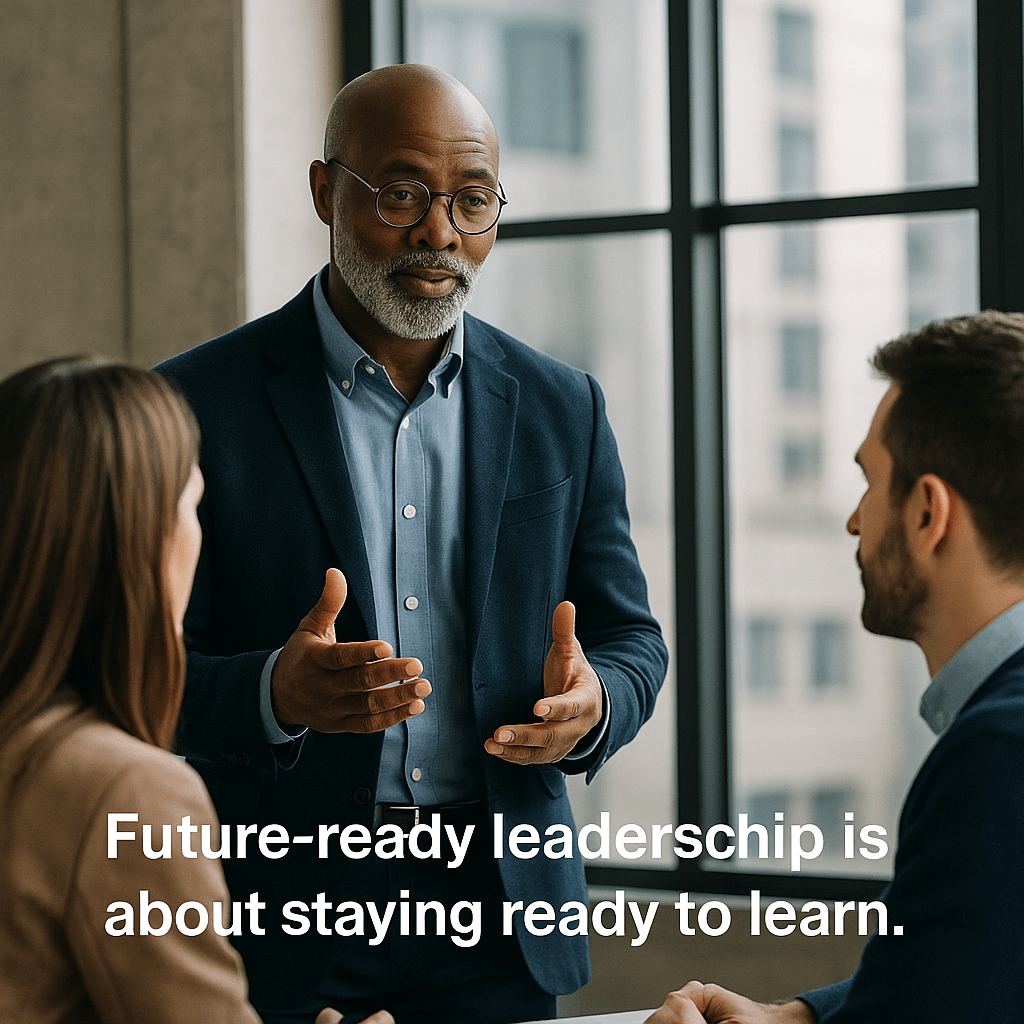
An experienced business leader speaks with two colleagues in a modern office with large windows overlooking a city skyline, symbolising forward-thinking leadership and continuous learning for the future.

The past year has tested every kind of leader. Unpredictable markets, evolving technology and new expectations around work have forced us all to adapt faster than ever.

Some leaders tried to go back to how things were. Others learned, adjusted and found new ways to move forward. Those are the ones shaping what leadership will look like in 2026 and beyond.

Future-ready leadership isn’t about having all the answers. It’s about staying ready to learn.

Adaptability beats certainty

In times of change, it’s tempting to search for solid ground. The perfect plan, the right process, the final answer. But if 2025 taught us anything, it’s that adaptability always wins over certainty.

According to *Deloitte’s Global Human Capital Trends report, 90% of executives believe building adaptable workforces is a top priority for long-term success. The challenge isn’t knowing change will come, it’s preparing people to navigate it confidently.

Future-ready leaders build flexibility into how they think, plan and lead. They don’t resist change. They anticipate it.

Trust drives performance

As technology takes on more tasks, the value of human connection has only grown stronger. The best leaders are those who create trust within teams, across functions and between people and technology.

*Gallup’s research continues to show that teams with high trust levels outperform low-trust teams by over 40% in engagement and productivity.

Trust isn’t just built through policies or performance reviews. It’s built through small, consistent actions. Following through on what you say, sharing context and giving credit where it’s due.

Clarity creates calm

Uncertainty fuels anxiety and anxious teams rarely perform at their best. Leaders who communicate clearly (even when answers are incomplete) give their teams something to hold onto.

Future-ready leadership is about translating complexity into direction. It’s about helping people see where they’re heading, even when the path isn’t fully mapped out.

Clarity creates calm. Calm enables progress.

Leading into what’s next

As 2025 comes to a close, it’s clear that the pace of change isn’t slowing down. The leaders who will thrive in the year ahead aren’t necessarily the most experienced or technical. They’re the ones who stay curious, trust their people, and communicate with purpose.

Leadership has never been about perfection. It’s about progress. One conversation, one decision and one learning moment at a time.

Want to go deeper?

If you’re looking to strengthen your leadership for the year ahead, explore my coaching and course options at CBDS. They’re designed to help you stay adaptable, focused and ready for whatever’s next.

*Sources

Posted on Leave a comment

AI Leadership Sweet Spot: Where Humans and Tech Work Best

A focused female business leader sits in a modern office interacting with a glowing holographic data display, symbolising the balance between human insight and AI technology.

Every few years, a new wave of technology comes along that promises to transform how we work. Right now, that wave is AI.

Some leaders are diving in headfirst, automating everything they can. Others are holding back, worried it will cause more problems than it solves. The truth as usual, sits somewhere in the middle.

The smartest leaders are finding a balance. They’re learning where AI can help, where it can’t and how to keep people at the centre of the process.

That’s the real AI leadership sweet spot.

Use AI for data, not direction

AI is brilliant at analysing data, spotting trends and speeding up repetitive work. But it doesn’t understand your customers, your culture or your strategy the way you do.

Great leaders use AI to inform decisions, not make them. They take what the tools surface and then apply judgment, empathy and context.

Think of AI as a second brain. Fast, capable, but not always right. You still need to lead with intuition and experience.

Keep people in the loop

When teams feel excluded from how AI is used, trust drops fast. The best leaders don’t just bring in new tools, they bring their teams on the journey too.

*Research from Harvard Business Review found that 72% of employees who understood why AI was being introduced felt more confident about its use at work. Transparency turns uncertainty into curiosity.

Share openly about what AI is doing, how it helps and what stays firmly human. It makes adoption smoother and strengthens your leadership credibility.

Lead with clarity, not complexity

AI can make things faster, but speed isn’t always progress. If you chase every shiny new tool, you’ll end up creating confusion instead of efficiency.

Set a clear purpose for how you use AI. Whether that’s improving response times, freeing up focus time or supporting better decision-making. Then make sure every tool or workflow serves that purpose.

Clarity is what separates leaders who use AI strategically from those who just experiment.

Finding the balance

AI isn’t replacing leaders. It’s challenging them to lead differently.

The real advantage isn’t in the technology itself. It’s in knowing how to combine the precision of machines with the perspective of people.

When you get that balance right, you move faster, stay focused and make smarter choices without losing the human touch that sets great teams apart.

Want to go deeper?

If you’re exploring how to bring AI into your business with confidence, take a look at my course AI in Business. It’s designed to help leaders build practical, people-first strategies for the AI era.

*Sources

  • Harvard Business Review: AI’s Trust Problem – explores what drives scepticism and how organisations build trusted AI.